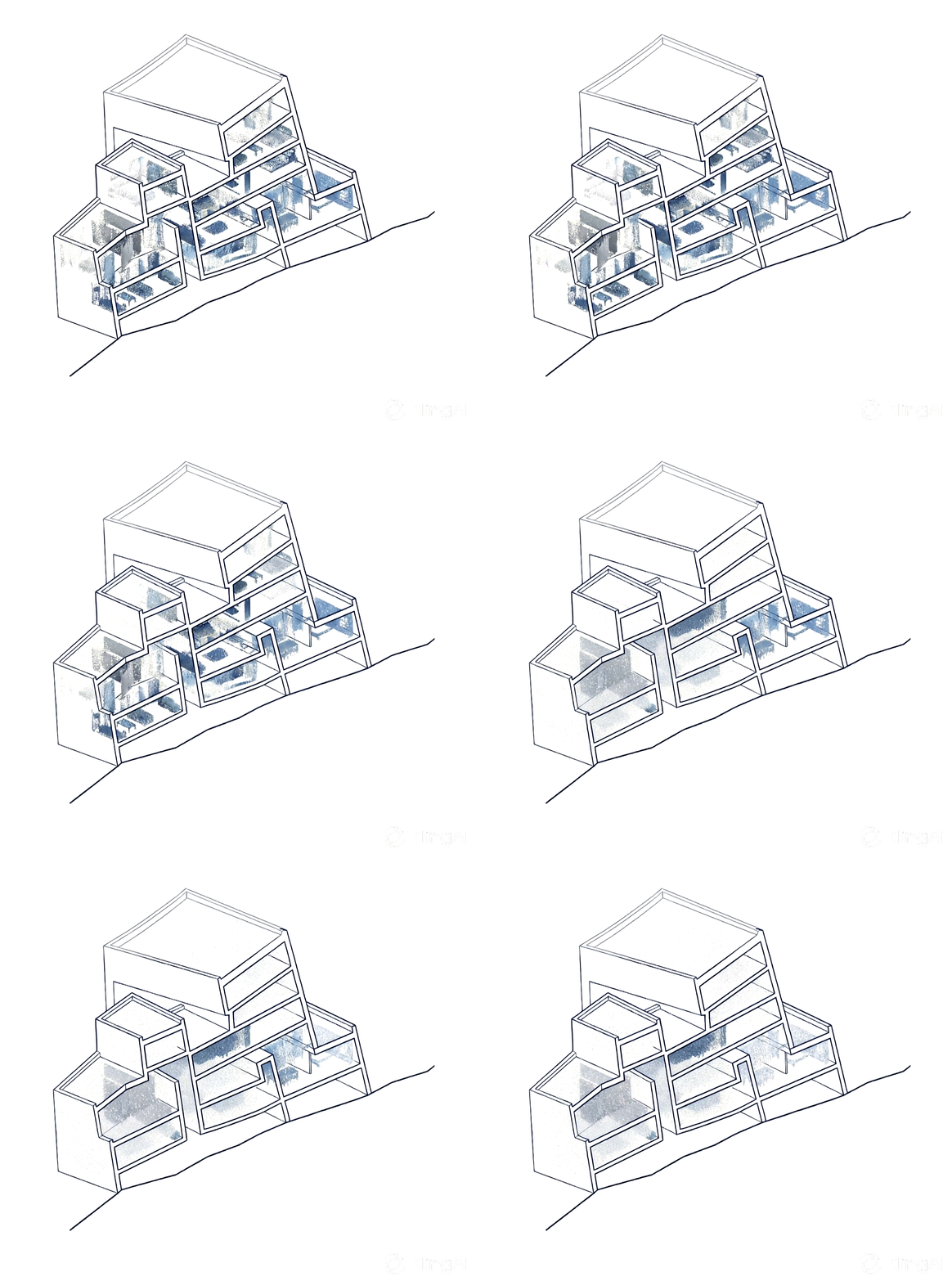

Spatial Synthesis

From Classical Representation to Contemporary Modes

For centuries, architecture has relied on drawings and models to abstract space before it could be built. Today, AI and immersive media allow designers to experience space directly—without secondary representations. This studio brings that shift into architectural design processes.

ARCH 702 Senior Research Studio · Winter 2026 · SAPL, University of Calgary
Jinmo Rhee · jinmo.rhee@ucalgary.ca · www.jinmorhee.net · www.destectic.net
Spatial Intelligence

Jinmo Rhee

Dr. Jinmo Rhee, an assistant professor at the School of Architecture, Planning and Landscape at the University of Calgary, is a computational designer, architect, and design scholar, delving into the transformative realm of artificial intelligence technologies within architectural design and built environment research. Dr. Rhee holds a Master of Science in Computational Design from Carnegie Mellon University and Ph.D. within the same institution. His research focused on advancing computational design methodologies in architecture and urban planning, particularly through the integration of AI and machine learning. His work has aimed to propose new lenses for reading urban and architectural design, to develop solutions for complex spatial challenges, and to explore new forms of creativity sparked by these emerging technologies. Recently, he is exploring a data scientific framework to reinterpret space and form, uncovering novel and creative design methods and knowledge.

Research Areas

Computational Design · AI & Design · Generative Systems · Computational Urban Morphology · Spatial AI

Recent Papers

  • 2026 Manuel Ladron de Guevara, Jinmo Rhee, et al. — "Tokenizing Buildings: A Foundation Transformer For Layout Synthesis" in CVPR 2026
  • 2026 Jinmo Rhee, Kiarash Kiany, Alberto de Salvatierra — "Revealing Implicit Associations Between Urban Form and Socioeconomic Indices" in Environment and Planning B
  • 2023 Jinmo Rhee, Ramesh Krishnamurti — "An Inductive Method for Classifying Building Form" in Environment and Planning BMichael Breheny Prize

Recent Research

  • 2025–26 PI, Generative Layout System for Residential Floorplans, Higharc, CAD $147K
  • 2025–28 Co-PI, CCC x 801: SAPL's presence in Downtown Calgary, City of Calgary, CAD $132K
  • 2025–27 Co-PI, Social Innovation for Climate-Neutral Cities, SSHRC/NFRF, CAD $250K
  • 2025 PI, Reimagining Generative Design Across Disciplines in the Era of AI, UofC Transdisciplinary Grant, CAD $8.5K
  • 2023–25 Co-PI, ROI Urban Modelling Pilot, Alberta Real Estate Foundation, CAD $260K
  • 2023–24 PI, Automated Camp Layout for Refugee Settlement Design, UofC VPR Catalyst, CAD $18K
  • 2020–23 PI, Generative Design for Apartment Layout Using AI, DL E&C, USD $220K
Motivation
01

Motivation

Architectural design has long depended on secondary representations—drawings, models, and perspectives—to make space intelligible before it could be designed. While these media enabled abstraction and control, they also positioned spatial experience as something deferred. Recent advances in AI-based world models and immersive media disrupt this condition by allowing designers to encounter space directly, at eye level and in sequence, without first translating it into drawings or models. Despite this shift, architectural education has yet to integrate direct spatial experience as a primary design medium.

This studio is motivated by that gap. It treats inhabitable, experience-based space not as a final visualization, but as the starting point of design, and explores how this reorientation reshapes architectural thinking, representation, and process.

02

Method

Phase I — Representation to Spatial Synthesis

Step 01 Observe & Represent

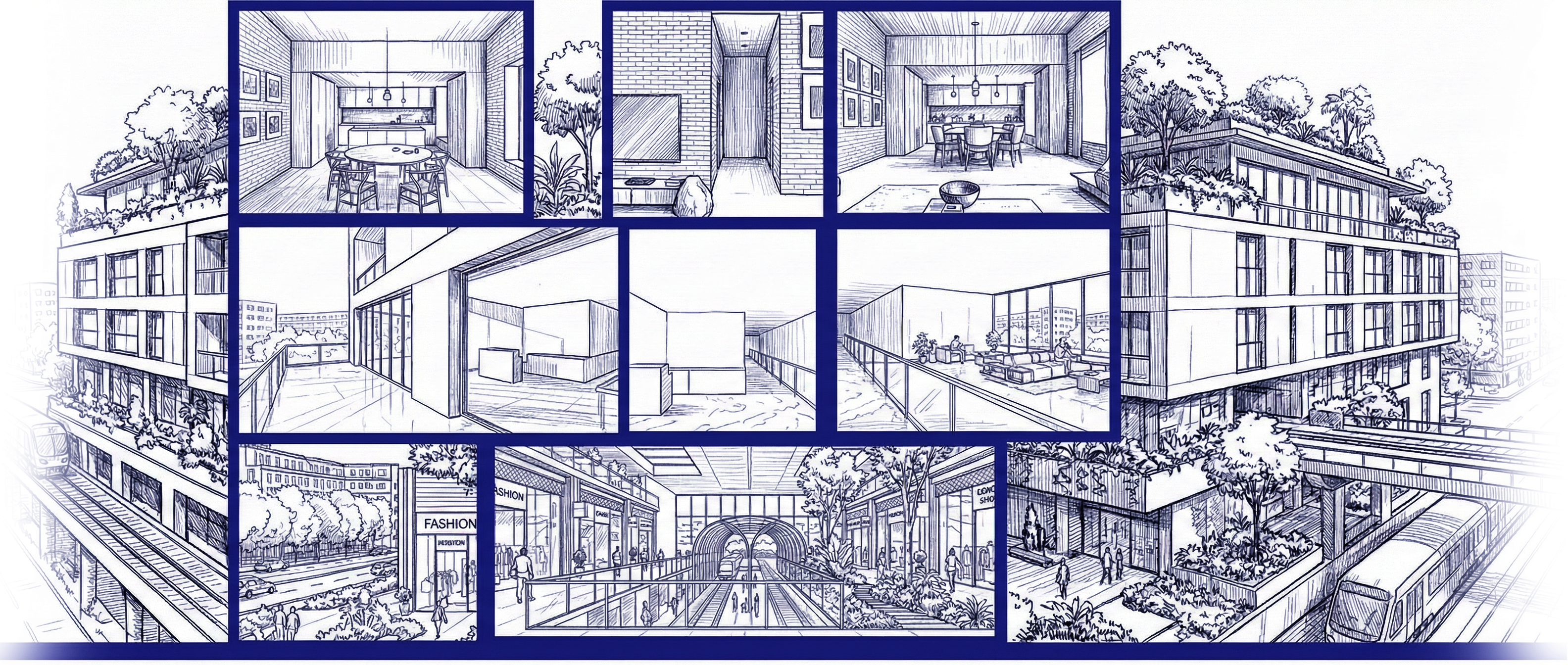
Develop spatial understanding through classical representations such as perspective drawing, sketching, and collage.

Step 02 Interpret & Translate

Analyze spatial qualities—scale, depth, atmosphere, and sequence—embedded in these representations.

Step 03 Synthesize Space

Use AI-assisted workflows to synthesize representational fragments into coherent spatial constructs.

Phase II — Designing through Experience

Step 04 Inhabit the Model

Translate synthesized spaces into inhabitable worlds, enabling direct, eye-level spatial experience.

Step 05 Iterate in Space

Design by navigating, testing, and modifying space through immersive review and simulation.

Step 06 Construct Spatial Sequences

Refine spatial continuity and narrative through connected spaces, culminating in a walkable world.

03

Deliverable

  • Research Document Annotated survey of tools, techniques, and precedents informing spatial intelligence workflows.
  • Prototype Portfolio A curated collection of spatial experiments using AI-assisted representation and synthesis tools.
  • Design Project An architectural proposal developed through spatial intelligence methods.
  • Final Presentation A VR-enabled portfolio and design project presented within an immersive review environment, using a provided publication template to support spatial navigation, critique, and exhibition.
Collage

Prototype Portfolio with an Example Design Project

Spatial Synthesis : Synthetic Space

A Selective Course in Collaboration with University of Arkansas

This selective explores an emerging workflow where hand sketches evolve into multi-perspective spatial constructs through generative AI and world-model technologies. Sketches become prompts for producing diverse spatial images—interior, exterior, oblique, and sequential views—that expand the designer's capacity to think through form, atmosphere, and inhabitation.

Building on generated images, the course advances toward 3D representation using world models to convert 2D views into navigable room-scale environments. Students combine, stitch, and collage these rooms to form architectural aggregates—providing the technical and conceptual foundation for the collage-of-rooms methodology central to the ARCH 702 Senior Research Studio.

Kate McLean

Adjunct Professor, University of Arkansas

Kate McLean is a design strategist and UX researcher bridging human-centered design, strategic foresight, and design pedagogy. She served as Lead UX Researcher at Tyson Foods, building internal UX practice and design thinking training. She holds an MDes in Interaction Design from Carnegie Mellon University and an MA in Design from Kenyon College.

Pedro Veloso

Assistant Professor, University of Arkansas

Dr. Pedro Veloso is an architect and computational designer whose work lies at the intersection of generative design, AI, and interactive spatial systems. He holds a Ph.D. in Computational Design from Carnegie Mellon University. His research explores generative design through agent-based systems and reinforcement learning. He is a co-founder of CRAIDL (Creative AI and Design Launchpad).

Supported by Industry and Research Partners

Partners